Red Light Therapy: The Science Behind the Glow
Longevity Science

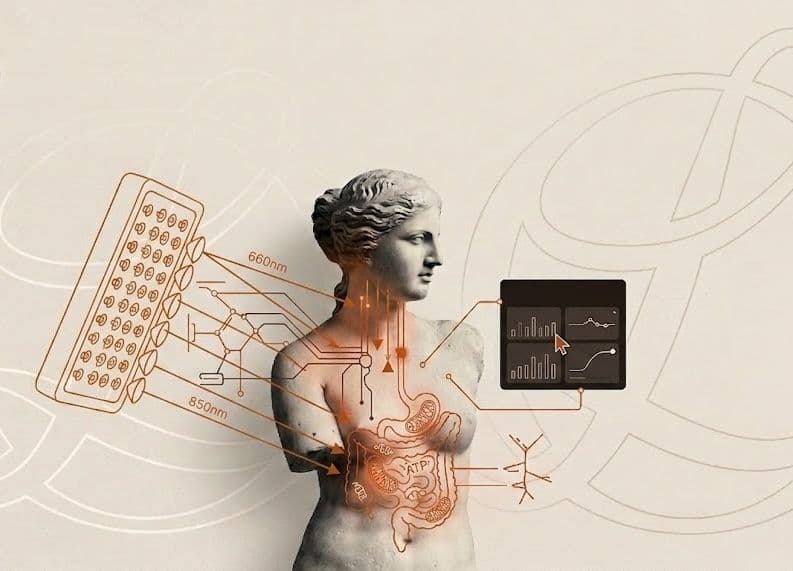
There is something almost counterintuitive about the idea that light - the same fundamental force that drives photosynthesis and sets our circadian rhythms - can penetrate human tissue and change the way our cells produce energy. And yet this is precisely what decades of research into photobiomodulation (PBM), more commonly known as red light therapy, has demonstrated with increasing precision.
This is not a wellness trend. It is a physiological intervention with a documented mechanism, a growing body of clinical evidence, and formal endorsement from some of the most rigorous medical bodies in the world.
What Red Light Therapy Actually Is
Photobiomodulation uses specific wavelengths of light - primarily in the red (630-660 nm) and near-infrared (810-850 nm) range - delivered through LEDs or low-level lasers at intensities that generate no significant heat. The light is applied directly to the skin, where it penetrates to varying depths depending on wavelength: red light reaches the dermis and superficial tissue, while near-infrared light can access deeper structures including muscle, bone, and, in some protocols, neural tissue.
The key distinction from other light-based therapies is the absence of ionising radiation. Unlike UV light, which damages DNA and drives oxidative stress, red and near-infrared photons are non-destructive. They do not alter the genetic material of cells. What they do alter is the energy-producing machinery inside them.
The Mechanism: What Happens at the Cellular Level
Understanding why red light therapy works requires a brief visit to cell biology.
Inside virtually every cell in the human body is a structure called the mitochondrion - the organelle responsible for converting nutrients into adenosine triphosphate (ATP), the molecule that powers essentially all cellular activity. Mitochondria are not passive processors. They are sensitive to their environment, and their efficiency is directly tied to cellular health.
A protein complex within the mitochondria called cytochrome c oxidase (CcO) acts as the primary photoreceptor for red and near-infrared light. When photons in the therapeutic wavelength range are absorbed by CcO, they trigger a chain of biochemical events: electron transport improves, mitochondrial membrane potential increases, and ATP production rises. At the same time, the cell's antioxidant defences are upregulated - reactive oxygen species (the cellular byproducts linked to inflammation and ageing) are reduced.
The downstream effects of this mitochondrial activation are substantial. Cells with more available energy and lower oxidative burden perform their specialised functions more effectively: fibroblasts produce more collagen, immune cells respond more efficiently, nerve cells repair more readily, and muscle tissue recovers faster.
A 2024 peer-reviewed clinical study added a notable metabolic dimension to this picture: a single 15-minute session of red light therapy applied before a glucose challenge reduced post-meal blood glucose elevation by 27.7% in healthy subjects - suggesting that stimulated mitochondria not only produce more energy, but consume glucose more efficiently, with implications for metabolic health and insulin sensitivity.
What the Evidence Supports
Red light therapy is one of the few non-pharmacological interventions with a documented effect across multiple independent domains of health. The evidence base is not uniform across every claimed application, and rigorous clinical science demands that distinction be made between well-supported uses and areas where research remains preliminary.
Skin and tissue repair is where the evidence is strongest. Multiple randomised controlled trials have demonstrated that PBM increases collagen density, reduces fine lines, accelerates wound healing, and improves overall skin quality. One well-cited study measuring collagen thickness across 136 volunteers found significant improvements in skin complexion, texture, and ultrasonographically measured collagen density following a course of red light treatment.
Musculoskeletal recovery represents another well-supported application. PBM consistently shortens recovery time after exercise-induced muscle damage, reduces delayed-onset muscle soreness, and supports healing in tendon and joint injuries. Studies in athletic populations have reported recovery improvements in the range of 20-40%, making it a regular feature of high-performance sports medicine.
Inflammation reduction underpins many of the above effects. By reducing reactive oxygen species and modulating cytokine signalling, red light therapy has demonstrated anti-inflammatory effects at the tissue level. This is the mechanism behind its growing role in pain management and joint health.
Oral mucositis - painful ulceration of the mouth lining, most commonly caused by chemotherapy and radiation - is the application with perhaps the strongest institutional backing. Its evidence base is deep enough to have reached national and international clinical guidelines.
The Clinical Endorsements That Matter
One of the most significant markers of a therapy's scientific credibility is its inclusion in clinical guidelines produced by independent medical organisations. Red light therapy has reached this threshold in oncology supportive care - one of medicine's most evidence-demanding fields.
ESMO (the European Society for Medical Oncology) recommends PBM for the prevention and management of oral mucositis in patients undergoing head and neck cancer treatment, as well as in bone marrow transplant haematology. This is a recommendation based on systematic review of clinical trial data, not theoretical mechanism.
NICE (the UK's National Institute for Health and Care Excellence) recommends low-level laser therapy - the clinical term for PBM - for patients experiencing oral mucositis. Research conducted across NHS trusts adds further weight to this endorsement: PBM was found to reduce hospital admissions, lower the need for opioid pain relief, and decrease dependence on nasogastric feeding tubes in affected patients.
These endorsements matter for a specific reason: oncology bodies do not recommend interventions lightly. Their guidelines exist to protect vulnerable patients. The inclusion of PBM in this context signals that the evidence for at least some of its applications has passed the most demanding form of clinical scrutiny available.
In 2025, a multidisciplinary international panel of 21 experts published a formal evidence-based consensus on the clinical application of photobiomodulation in the Journal of the American Academy of Dermatology. Following a systematic review of studies indexed in Embase and MEDLINE, the panel confirmed PBM as a safe and effective treatment modality across several dermatological applications.
Safety
Red light therapy, when administered within established parameters, has a well-characterised safety profile. It does not cause the DNA damage associated with UV exposure. It does not generate significant heat at therapeutic intensities. No links to malignancy have been identified in clinical trial data - a point specifically assessed in a 2023 systematic review published in the Aesthetic Surgery Journal, which examined PBM's oncological safety and found no evidence to support the premise that it should be avoided by patients who have previously undergone cancer treatment.
As with any physiological intervention, dose matters. PBM follows a biphasic dose-response curve: too little light produces no meaningful effect; too much can blunt or reverse the benefits. This is why device quality, wavelength specificity, and dosing precision are not cosmetic details - they are the difference between a therapeutic outcome and a null result.
Where It Fits in a Longevity Protocol
The practical relevance of red light therapy within a longevity framework lies in its mechanism: mitochondrial function.
Mitochondrial decline is a well-established feature of ageing. As we age, mitochondrial efficiency decreases, ATP production falls, oxidative stress rises, and cellular repair becomes slower and less complete. This deterioration is not just a consequence of ageing - it is one of its drivers. Reduced cellular energy output means diminished function across every system that depends on it: cardiovascular, immune, neurological, musculoskeletal.
A therapy that measurably improves mitochondrial function, reduces oxidative stress, and accelerates cellular repair is, by definition, acting on one of the root processes of biological ageing. This does not make red light therapy a cure for ageing. What it does make it is a well-supported, non-invasive tool for supporting the cellular conditions that allow the body to repair, maintain, and perform at a higher level - for longer.
At Longevity One, we apply red light therapy as part of structured protocols designed around individual biomarker profiles. The goal is not light exposure for its own sake. It is measurable improvement in the biological markers that reflect how well your cells are actually functioning.
The science has moved well beyond speculation. The question now is whether you are using it.
Stop Guessing
Start Measuring
Book your initial consultation and receive a complete biological assessment.